MBB Preview: Utah State Eyes Title Claim At UNLV
I don't usually unlock preview stories, but this one felt good coming off the bat, and I'll make a "playing for a title" exception this time. Utah State-UNLV. MBB Preview:
Utah State has produced more than its fair share of great teams. When you play the game for more than 120 years in a basketball-crazed town, that's bound to happen.
The list of Aggie squads to push beyond great, earning instead the distinction of champions, is far harder to crack. Plenty of college basketball squads are great. Few can back it up with a trophy.
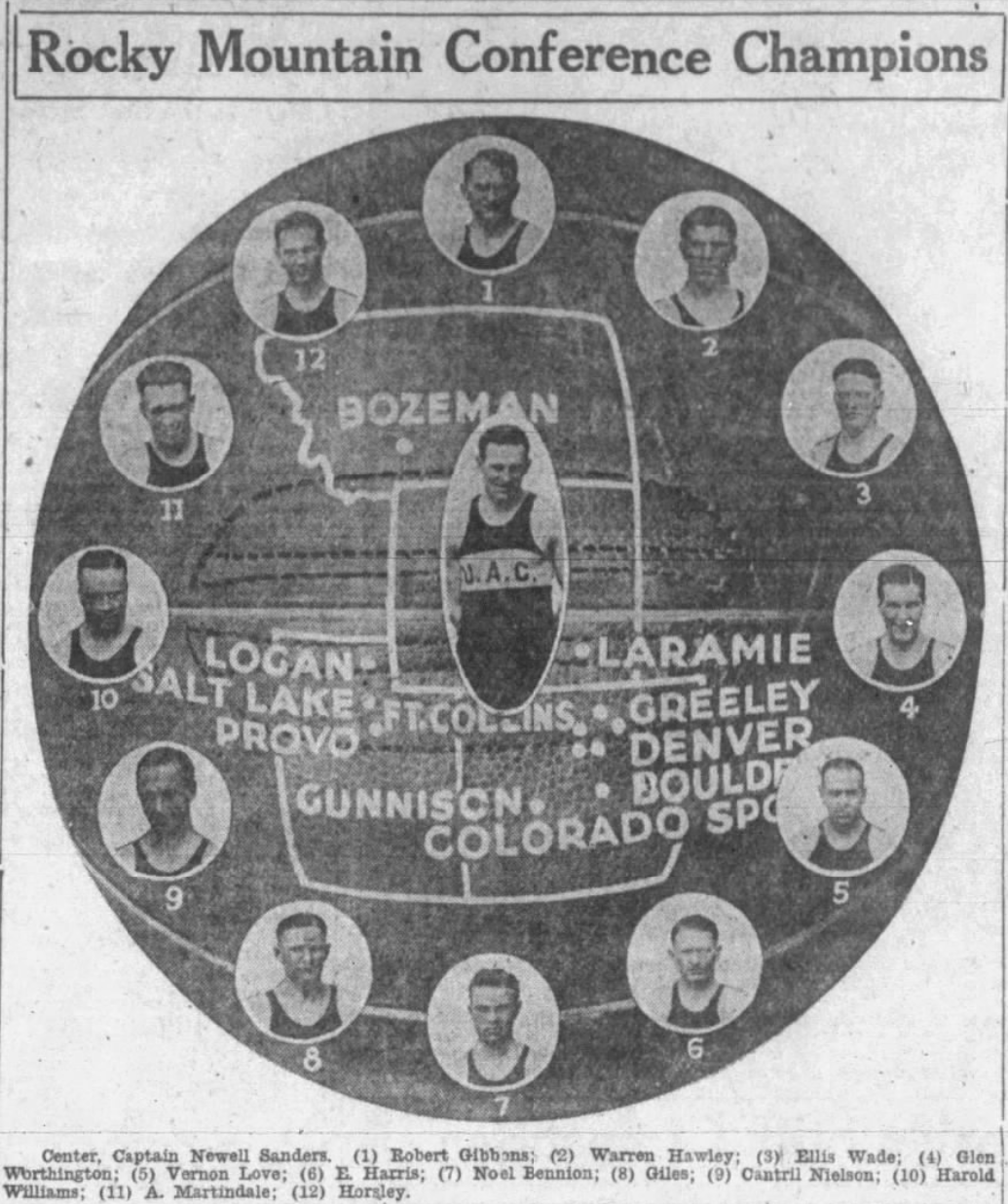
This is how the first Aggie bunch formally recognized as such was honored in the pages of the Salt Lake Tribune on March 14, 1926 – 100 years to the day from this season's scheduled Mountain West tournament championship game.
On the floor, they had in fact sealed the title two days prior, claiming their second win in what would become a three-game sweep of the Colorado State Teachers College. The Aggies were led before their home fans by the same men who had led them all season: Star scoring forward Warren Hawley, captain and lead guard Newell Sanders and fearsome center Glen Worthington. Sanders and Worthington carried much of the first game's load with 10 and 12 points, respectively, while Hawley directed the second effort on a 15-point night. Game three, effectively an exhibition, again saw Hawley pace the Aggies with 14 points.
Not all league titles have come about so swiftly. Utah State's next title squad, in 1929-30, needed the third game to decide its series with Montana State, which it had already played and beaten in the two games immediately preceding the championship series. The first Aggie teams to truly venture away from home for postseason play, the 1934-35 and 1935-36 sides, first rolled to relatively easy Rocky Mountain Conference crowns. They tallied a combined 18-6 league mark and dispatched Eastern Division winners Northern Colorado (1934-35) and Wyoming (1935-36) in two games apiece.
It would be another 40 years, thanks in large part to two decades of independence in the 1960s and 70s (which also happened to be two of the program's strongest decades), before Utah State earned another league title.
Rod Tueller snapped the drought in his first year at the command, 1979-80, and earned the Aggies their first regular season championship in the more modern tradition of league title races – which split the standings from a postseason tournament and award two championships.
They did it in dramatic fashion, claiming the outright honors by beating defending PCAA champions Pacific, 91-78, on the final day of the regular season. At the time, it was only the second road win for Utah State against Pacific in 30 years. Tueller bookended his tenure with PCAA championships, winning another in 1987-88, albeit this time in the postseason tournament with three tight wins over San Jose State, UC Santa Barbara and UC Irvine.
Larry Eustachy enjoyed his breakthrough campaign at the helm in 1994-95, as the Roddie Anderson, Eric Franson, Silas Mills and Corwin Woodard-led Aggies cleared Long Beach State and New Mexico State by one game with their 14-4 mark to claim the outright Big West regular season championship. He had another title team in 1997-98, his last group doing it in the postseason tournament much like Tueller's, but the true run of conference supremacy in Logan ultimately began with his departure – and far more importantly, with the arrival of Stew Morrill.
Morrill's dominance of the Big West, and eventually of the WAC, remains the program's modern foundation, even as it approaches the 30-year anniversary of his hiring. Without Morrill and his 13 league trophies (seven in the regular season, six in tournaments), there would be no Craig Smith, Sam Merrill or Neemias Queta, who led the Aggies to their first three Mountain West championships.
Nor would there be Danny Sprinkle and his fabulous 2023-24 squad, the last league winners in Logan. In a season with six Mountain West representatives granted NCAA tournament berths, the story of a team pieced together on the fly and held in place by sheer force of will (and by Darius Brown, but I repeat myself) grows more preposterous with each passing year.
These groups, which share little in common beyond the university on their degrees and their status as champions, represent the standard in Logan. It's a topic second-year head coach Jerrod Calhoun refers to often, usually followed closely by praise of players who understand what it means to wear the uniform and represent Utah State basketball.
Now, Calhoun's Aggies are 40 minutes from joining the hallowed fraternity. To do so as outright champions will require more, either in a senior day win over New Mexico or mid-week losses from both the Lobos (hosting Colorado State on Wednesday) and San Diego State (at Boise State on Tuesday), but the ball coach is hardly concerned with that right now. He, his staff, and his players have spent nearly every day of the past 11 months working toward this moment, and at long last, it's here.
"I don't know anything about the tiebreakers," Calhoun said. "I couldn't tell you if we win a game, lose a game or win two. Obviously you know where you're at, but I haven't looked at that yet. We have talked about how we're 40 minutes away from winning a championship. I think the kids all know that. There's no need to hide from that. It won't be easy and we know that, but ultimately when we put the team together in the offseason.
"Everybody throughout the recruiting process talked about the right things. They talked about winning, and that's why they're here. If we don't hear guys emphasizing winning and the parents talking about winning, they're usually not a part of our team. I think the winning DNA is really ingrained in this team, and you've seen that throughout the year. Every team goes through some ups and downs, but I think our guys have stayed the course throughout the college basketball season, and I think they see what's in front of them. I really do. Ultimately, it comes down to execution. You have to have a good game plan and then you have to carry that out."
Standing in Utah State's way on Tuesday night are the UNLV Runnin' Rebels – one of only four league teams to topple the Aggies this season, and the only one in or out of conference play to do so in Logan. They're woefully inconsistent, freakishly long, and every bit as athletic as any team in the Mountain West, just as seemingly every UNLV group has been since Utah State joined the league. They have the only player, Dra Gibbs-Lawhorn, posing anything resembling a viable threat to Mason Falslev's MWC Player of the Year campaign.
"Obviously, Gibbs-Lawhorn is on a tear," Calhoun said. "It's something this league hasn't seen in a number of years. He's a terrific player. They're shortening their bench, I think that's changed. They're not playing as many guys. The style of play is a little bit similar but also different, they're doing different things defensively. I think a lot of things change throughout the year, but (three things are) pretty consistent. They're very athletic, they're very long and they're very good at home."
And to the Aggies, at least if they heed their coach's words, they're just one more team in the way.
"It really isn't about UNLV at this point, it's really about winning a championship," Calhoun said. "If you win the game, you're champs. If you win two games, you're outright champs. That needs to be our sole focus. But, we have to learn from the first game. We got beat on block-outs, we got beat in the last five or six minutes and we got kind of dominated for the last six minutes inside the Spectrum.
"They have high-level athletes to rebound the ball and block shots. There's a lot of things that come with playing a UNLV team, and certainly it's in our memory book, but it's really not about them. It's about this group trying to get a title and trying to go down in history."
Projected Lineups

Players To Know
Jacob Bannarbie: The importance of Jacob Bannarbie in Tuesday night's clash will depend primarily on the status of 7-0, 230-pound sophomore Emmanuel Stephen.
Utah State knows all about the Nigerian-born big man, who transferred to UNLV from Arizona this past offseason. Despite four fouls, he was among the most dangerous Runnin' Rebels in last month's stunner, recording 31 minutes, 10 points on 4-of-5 shooting (2 for 2 on free throws), eight rebounds, one block and one steal. He impacted far more shots around the rim than his stat line would suggest, causing constant trouble both for Utah State's frontcourt players and its perimeter slashers.
His performances since that game have left something to be desired. Stephen averaged only 18.8 minutes, 3.0 points (38.1 percent from the field), 5.3 rebounds and 1.2 blocks per game while fouling 3.5 times a night. Josh Pastner dropped him from the starting lineup after 15 middling minutes against San Jose State on Feb. 10, and has turned to him only briefly in five games since.
In fact, Stephen didn't play at all during UNLV's overtime win over Nevada on Feb. 28. If an injury is limiting the big man, there has been no reporting to indicate as much – it seems he's simply fallen from Pastner's good graces. His loss has been Bannarbie's gain.
A 6-9, 235-pound redshirt sophomore, Bannarbie hails from Anchorage, Alaska, but spent much of his prep career at Southern California Academy (Encinitas, Calif.) before wrapping up as a senior at Hillcrest Prep in Phoenix. He signed with UNLV, then led by Kevin Kruger, over offers from Portland, San Francisco and Washington State and spent his first season in town developing as a redshirt.
Bannarbie made his UNLV debut in 2024-25, appearing in 19 games and even making three starts, but his impact was limited largely to non-conference play. He made only 10 league appearances, none for more than seven minutes, and ended the season averaging 1.6 points and 1.8 rebounds in 6.6 minutes per game.
In the small sample size, Pastner saw potential from the young big man and decided to keep him around on his first roster at the helm. An injury held him out of four games from the end of November into the first week of December, but Bannarbie impressed early and established himself in the rotation. He logged a 12-point, 11-rebound double-double against Saint Joseph's, chipped in five points, five boards and five assists in UNLV's league opener against Fresno State, and briefly held the starting center role through the first two weeks of MWC play.
Then, it was Stephen who forced his way past his counterpart, knocking Bannarbie from the starting five in early January. For much of the month to follow, the redshirt sophomore flirted with another fall from the rotation, appearing sparingly and doing relatively little of note with the time he did have. That changed on Feb. 7, when UNLV knocked off Grand Canyon in Las Vegas, 80-78.
With Stephen and forward Kimani Hamilton in heavy foul trouble, held to 11 and 20 minutes respectively, Bannarbie was forced into major action. He scored only five points on 2-of-4 shooting, but he made the most of his chance elsewhere, totaling 15 rebounds (!!!), five assists and a block in 29 minutes. His ascent into a larger role was not immediate – he followed the GCU outburst with five minutes of nothing against San Jose State – but the seeds of doubt had taken hold in Pastner's mind. Looking for more from his center position, he decided to give Bannarbie another crack at the starting five on Feb. 13 at Boise State.
UNLV again staged the upset, and Bannarbie again played a valuable role in the effort, adding nine points on 3-of-7 shooting and three rebounds in 15 minutes. After a return to the bench against Colorado State, Pastner decided to make the move official, rolling with Bannarbie as the starting center in each of UNLV's last three games.
He's fouled out twice, which will be a point of emphasis for Utah State on Tuesday night, but his performances have otherwise left the coach with little to complain about. Bannarbie was fine, if unremarkable against Air Force and Grand Canyon, but he played the finest game of his young career in the rivalry game win over Nevada. Logging 34 minutes before fouling out, he racked up a career-best 15 points on 6-of-8 shooting (3 of 7 at the line) with six boards and some solid defense.
Though the volume is obviously extreme compared to his standard performance, that game does capture the general idea behind Bannarbie's inclusion in the leading group. He's nowhere near the interior defender that Stephen is, and somehow still fouls almost as often as his counterpart, but his work as a rebounder is similarly strong, and most importantly, he's not a liability offensively. When his shots are falling in the paint, he may even qualify as an asset. Neither can be said of Stephen, who stands out as perhaps the single worst finishing center in the MWC.
Howie Fleming Jr.: A native of Louisville, Howie Fleming Jr. will suit up for the final regular season home game of his marathon collegiate career on Tuesday night.
The 6-5, 210-pound guard has been all over the nation since his senior season at Louisville Male High School, when he averaged 15.8 points and 7.0 rebounds per game before having his final prep campaign cut short by the COVID-19 pandemic.
He began his career at nearby Illinois State, playing a major role for the Redbirds as a true freshman point guard. Fleming made 24 appearances and 13 starts on the year, pitching in 3.8 points, 4.7 rebounds, 2.8 assists and 0.8 steals in 22.5 minutes per game.
His second season at Illinois State followed much the same path. He started 23 times in 30 games, averaged 22 minutes a night, and did a bit of everything with his time, averaging 5.9 points, 4.2 rebounds, 2.1 assists and 1.3 steals per night while shooting 46.6 percent from the field and 40.0 percent from three.
That marked the end of head coach Dan Muller's term at the helm of the program, and in turn, the conclusion of Fleming's stint in town. He hit the transfer portal upon Muller's departure and found a new home at Winthrop, this time as a small forward under coach Mark Prosser. It didn't work out. The Eagles struggled to a 15-17 record and Fleming hardly played, sidelined by multiple injuries and limited ultimately to only 10 appearances.
Until the 2024-25 season, that was the last college basketball heard from Fleming. When he re-emerged at UT Rio Grande Valley, he had bulked up to play a small ball forward role for the Vaqueros. As it turned out, that was exactly what he needed for his long-awaited breakout campaign.
Fleming starred in his lone season at UTRGV, making 31 appearances and 25 starts while serving as one of the team's top scorers, rebounders and passers. He averaged 12.3 points (56.0 percent shooting from the field, 42.2 percent from three), 6.4 rebounds, 2.4 assists and 26.6 minutes per game, attracting Pastner's attention when he decided after the campaign to journey once more into the portal.
Though he's serving more as a winger than an undersized forward for the Runnin' Rebels, his output has been similarly strong. His scoring is down to 9.2 points per game, thanks mostly to a dip in his overall shooting (44.4 percent) and a collapse from beyond the arc (29.4 percent), but he's found other ways to impact the game.
Firstly, on the offensive end, he's made up for the lack of perimeter shooting with a career-best 52.7 percent free throw rate, attacking the basket early and often while converting 79.8 percent of his attempts at the stripe. He's also enjoying his most prolific season as a playmaker, leading UNLV's passing efforts from the wing with 3.6 assists per game and a solid 21.2 percent assist rate – though the corresponding 20.8 percent turnover rate is still too high, and has nagged Fleming for his entire collegiate career.
Just as important as his offensive output, if not more so, is Fleming's steady work as a rebounder and defender. He's averaging 6.0 rebounds per game to lead all Runnin' Rebels and contributing 1.2 steals a night, his most in a season since the 2021-22 campaign at Illinois State (1.3 SPG). Like the rest of this rotation, he has no hesitation trading fouls (3.7 per 40 minutes) for havoc plays on the defensive end, but he's only fouled out once in 27 games despite carrying roughly 28 minutes a night.
The senior is, if we're being blunt, the least potent of UNLV's four leading scorers. He doesn't stretch the floor like Hamilton or attack the rim like Tyrin Jones, and comparing any of the three to Gibbs-Lawhorn on that front is laughable. But, he's a key part of that unit all the same through some timely baskets and consistent playmaking efforts, and no one on the team has a better floor game. Barring early foul trouble, you'll likely hear his name quite a bit on Tuesday night.
Dravyn Gibbs-Lawhorn: Back in mid-January, when these two sides first met, Gibbs-Lawhorn was best described as a pleasant surprise. He had been a role player in an off-guard role for Illinois before transferring to UNLV, and his first two-plus months with the Runnin' Rebels were marked by the inconsistency of a player with myriad new responsibilities. Because of the preseason injury to Myles Che, Gibbs-Lawhorn was forced to slide into the point guard spot, where he had very little competitive experience. From the first preview:
"A native of Lafayette, Indiana, Gibbs-Lawhorn spent the bulk of his prep career away from his home state. Though he began at the local McCutcheon High School, Gibbs-Lawhorn went all over the country to play his high school ball, spending time at Montverde (Fla.) Academy and Real Salt Lake Academy before his senior season, which unfolded at Word of God Christian Academy in North Carolina. He was a four-star recruit in the class of 2023 by the 247Sports composite rankings (No. 134 nationally) and considered a final four of Illinois, Indiana, Memphis and Purdue before signing with Brad Underwood and the Fighting Illini.
"In two years with the program, Gibbs-Lawhorn's chief responsibility was providing solid shooting guard minutes off the bench when starters Ty Rodgers (2023-24) or Kylan Boswell (2024-25) needed a breather. He made 63 appearances in total for the program, two of them starts, and averaged a modest 11.4 minutes, 4.3 points and 1.3 rebounds per game. While he did see a larger role as a sophomore last season, averaging 14.9 minutes, 5.9 points (44.3 percent shooting) and 1.6 rebounds a night, he could not envision a path to a starting job when he looked at the 2025-26 roster. So, he hit the portal for a fresh start and found it at UNLV.
"The original plan was not for the 6-1, 185-pound Gibbs-Lawhorn to average more than 32 minutes per game as UNLV's primary point guard, spelled only in spots by freshman Isaac Williamson. He was a slasher and sharpshooter from the shooting guard spot at Illinois, and Pastner intended to keep him in that role as half of a backcourt with Che, who averaged 12.1 points, 2.8 assists and 2.4 rebounds as a starter for UC Irvine last season. Che has still yet to appear for the Rebels this season, though, and Pastner needed a point guard, so he put the task to Gibbs-Lawhorn.
"There have been growing pains, understandably. Gibbs-Lawhorn is only averaging 3.0 assists with an 18.9 percent assist rate, among the lowest for MWC point guards, and the foul trouble he often faced at Illinois has followed him to Vegas (4.0 fouls per 40 minutes). He gave the ball away at least four times in games against Alabama (four TOs), Stanford (four), Tennessee State (five), La Sierra (six) and Boise State (five) and still falls back into old, non-point guard habits at times.
"As the season has worn on, though, Gibbs-Lawhorn has provided more positive moments than negative ones. He's averaging a team-best 16.8 points per game, shooting 46.9 percent from the field and 35.7 percent from three, while knocking down 81.5 percent of his free throws (30.2 percent free throw rate). Those numbers are boosted by a few high-scoring outings against Montana (26 points), Alabama (25), Fresno State (28) and Boise State (33), but explosive scoring is part of his game and should not be written off – when he gets rolling, he's nearly impossible to stop."
That final note about Gibbs-Lawhorn's capacity for explosive scoring has proven prescient over the last month and a half of this campaign. In fact, his performance against Utah State on Jan. 20 can be considered something of a catalyst, along with the 33-point eruption he enjoyed against Boise State the week before. Gibbs-Lawhorn dominated the Aggie defense in Logan, registering 21 points on 8-of-12 shooting with five rebounds and two steals in 35 minutes.
"I think Gibbs-Lawhorn is a first-team all-league player," Calhoun said. "I don't know what you guys think of him but somebody said he had like 40 tonight. The kid is way smarter than I could have ever imagined. He's so good in pick-and-rolls, he's so good at finding his teammates and I've been amazed at how he's playing. He's playing at a high, high level."
Beginning with that game, the junior from the Hoosier State has been the Mountain West's most prolific scorer by a wide margin. He's averaging an otherworldly 26.9 points per game while shooting 55.5 percent from the field, 49.5 percent from three (8.3 attempts per game), plus 3.1 rebounds, 2.2 assists and 1.8 steals in 36.1 minutes a night. Not only has he finished short of double figures just once in the 12-game stretch, with an eight-point showing against San Diego State, but that mark stands as his lone outing below 21 points since the trip to Logan. In his last nine games, a sample that excludes the Aztec outlier, Gibbs-Lawhorn has been good for nearly 30 points a night, sitting at 29.7.
UNLV has made a few minor schematic changes to facilitate his fantastic run of form, but the largest difference appears to be a matter of confidence. Gibbs-Lawhorn is attacking the rim more and finishing those drives more efficiently, albeit with a slightly decreased free throw rate. He's also attempting (2.1 shots per game) and making (48.0 percent) more mid-range jumpers, while depending far less on assists to score the ball. In his first 17 appearances, he did 50.5 percent of his overall scoring (87.5 percent from three, 31.1 percent on twos) from passes. In the last 12, his overall assisted rate is just 39.3 percent (79.6 percent on threes, 10.3 percent inside the arc).
Gibbs-Lawhorn can still facilitate for others, and remains prone to both turnovers and fouls, but this stretch is best viewed as UNLV essentially coming to terms with itself. The Runnin' Rebels aren't really suited for a rigidly structured, pass-heavy offense. They're without a true playmaker and have only four players who can be relied on for scoring. This team was primed for an unquestioned No. 1 option to emerge, and Gibbs-Lawhorn answered the call.
"He's really smart," Calhoun said. "That's the thing that really impresses me. He can play off-ball, he can play with the basketball in his hands, he can make off-the-bounce threes and catch-and-shoot threes. He's averaging 30 points a game for nine straight games. Obviously, he's extremely confident right now and he's really just an efficient player, his splits are incredible.
"I personally only saw it one other time, with a kid named Antoine Davis. He's the No. 2 all-time leading scorer in the history of college basketball. We had to prepare for him when he was at the University of Detroit Mercy. I think he ended up being 9-10 points off from Pistol Pete's record. I would compare (Gibbs-Lawhorn) to him. That's the only other time I've seen a player play this well."
Stats To Know
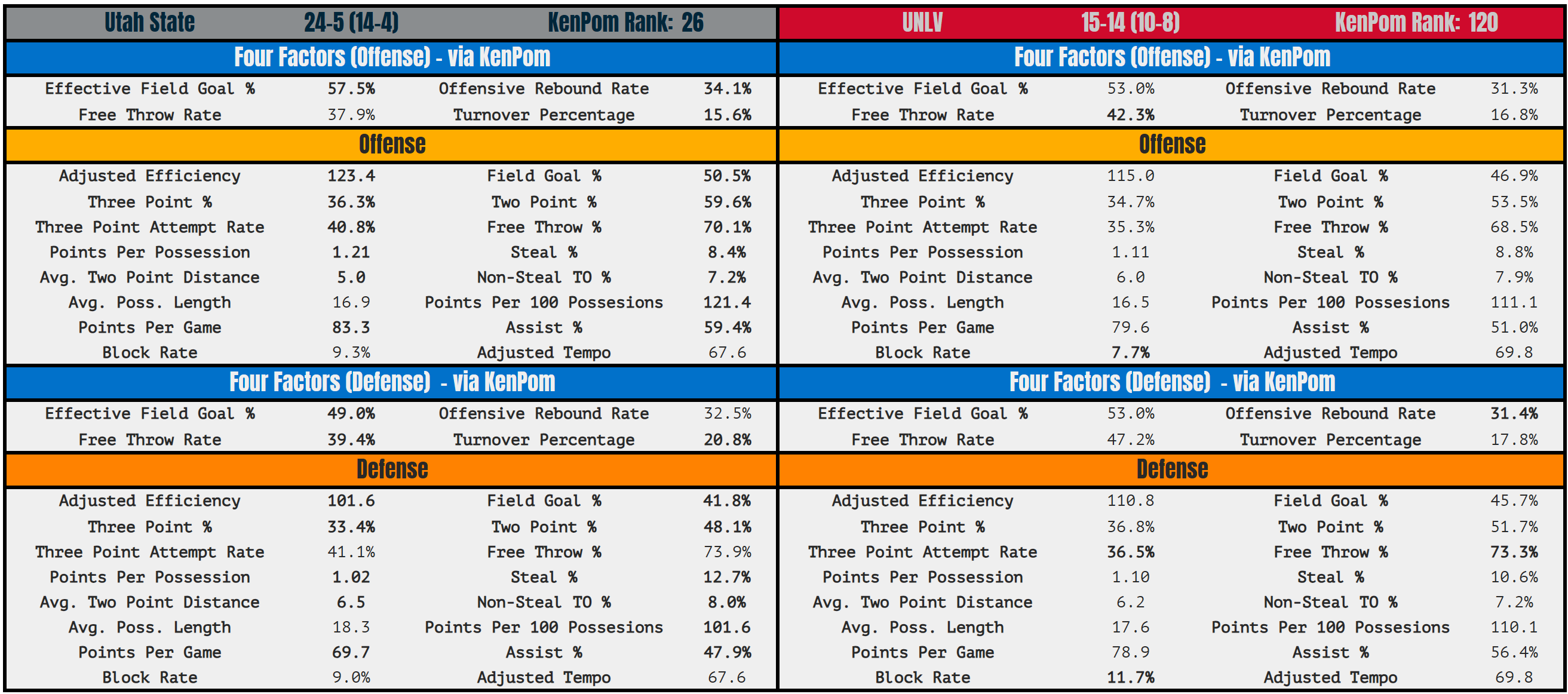
Block Rate: With or without Stephen in the primary rotation, UNLV blocks shots and protects the rim as well as just about any defense in the Mountain West, checking in with a 59th-ranked 11.7 percent block rate. Leading that effort with an individual block rate of 8.5 percent is Jones, the lanky freshman who took over January's meeting with Utah State in the second half.
He's not alone, though. Almost every member of this rotation has the athleticism and length to contest shots in the paint, and all of them are happy to try, even if it means frequent trips to the free-throw line for opposing offenses – and it usually does. Utah State struggled mightily to handle that a month ago, attempting only 24.1 percent of its shots at the rim (the season average is 32.1 percent) and settling instead for 20 non-rim shots in the paint, hitting just eight. To avoid a repeat of that game's result, the Aggies will need to be much smarter about navigating the trees in the paint in the half-court and beating them to the cup in transition.
"They had a lot to do with it," Calhoun said. "I think their rim protection is really good. We have to play better in transition. In the last three or four games, we're not spraying the ball ahead and getting paint touches in transition. Usually, it involves the paint. You have to get to the paint, whether it's in transition or attacking a closeout or a ball-screen, we have to get to the paint to be an efficient team."
Free Throw Rate: That first meeting carried plenty of what-ifs for the Aggies, none looming larger than their performance at the line. UNLV handed out 31 attempts, as it is wont to do with the nation's 357th defensive free throw rate (47.2 percent), but hardly suffered repercussions as Utah State knocked down only 17 of its tries.
It's bad enough on its own, but the Aggies compounded their troubles at the line by nearly matching UNLV's exorbitant free throw rate, giving away 25 freebies that the Rebels turned into 21 points. That's been a problem all season for Utah State's defense, which is 286th in free throw rate allowed entering Tuesday's matchup, and it has flared up significantly of late. The Aggies ceded 60 combined attempts in their last two road games at Nevada and San Diego State, effectively crippling their defense with a pair of free throw rates at or above 55 percent – entirely too high to win anywhere, let alone on the road against two good teams.
UNLV is, at least on paper, a step or two behind both the Wolf Pack and Aztecs in overall quality. It has no problem capitalizing on undisciplined defense, though, claiming a 33rd-ranked 42.3 percent offensive free throw rate built largely on the efforts of Jones (74.7 percent), Bannarbie (73.9 percent), Fleming (52.7 percent), Hamilton (46.8 percent) and Stephen (41.7 percent).
"I think foul discipline, and discipline in general, not just fouling, is critical," Calhoun said. "Showing your hands, not reaching, making sure you're blocking guys out. You can't get fouls away from the basket, I think we've picked up a lot of those which then have led to teams getting in the bonus. You want to keep them out of the bonus as long as you can, and you want to make teams earn baskets. Foul discipline and transition defense are the two biggest keys to improving our defense right now."
Offensive Rebound Rate: This one really speaks for itself at this point. Utah State has been outrebounded in six consecutive games, and has seen its offensive rebounding rate allowed plummet from slightly below average to outright dreadful, sitting currently at 32.5 percent and 281st nationally. Surrendering extra shots and giving away free points at the line is not a recipe for good defense.
"Here down the stretch, we have to improve our rebounding on both sides," Calhoun said. "We have to get to the glass and keep people off the glass. Those are things we'll emphasize, not just against UNLV but the rest of the way. I think teams that can control the paint, that can rebound and that can get early strikes in transition will be the efficient teams down the stretch."
UNLV's rebounding numbers on either end of the floor are not particularly notable, but Pastner's group can certainly take advantage if the Aggies are simply giving away second (and third) chances. The Rebels dominated the glass in Logan, 40-31, and nabbed 13 offensive boards in the process.
Prediction
Calhoun was not kidding: This one is all about Utah State.
Pastner's team has plenty of positive qualities, many of them revolving around Gibbs-Lawhorn and Jones, but they're 15-14 for a reason. The Rebels boast an above-average offense, dependent heavily on two or three players, middling rebounding units, and one of the Mountain West's worst defenses beyond their rim protection. Their upset in Logan was partially a matter of a few players getting red-hot from the floor at the right time, but that result falls chiefly on the Aggies. They played a poor game and suffered accordingly.
The margin for error is much smaller on the road, but the overall dynamic of the matchup really has not changed. UNLV is dangerous; Utah State is the better basketball team. If the Aggies bring a championship mentality to the Thomas & Mack Center, clean up the mistakes that spoiled their first matchup with UNLV and play their game, they'll return to Logan as champions.
Utah State 82, UNLV 77