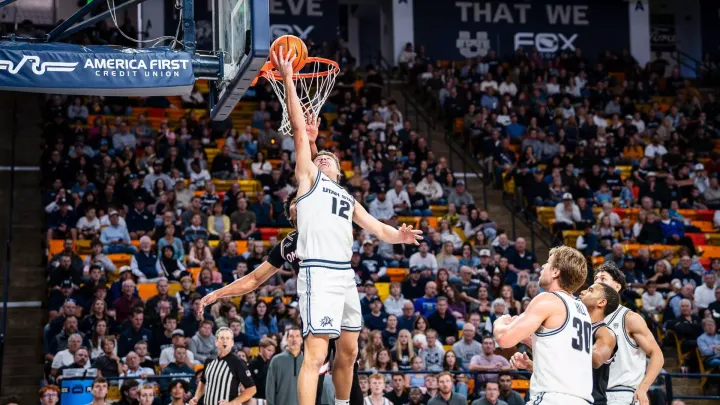
More Than A Decade In The Making, Falslev And Hall Thrive In Aggie Backcourt
On Mason Falslev and Dallin Hall, and a reunion more than a decade in the making in Utah State's superlative backcourt. Free for all to read (and share!):
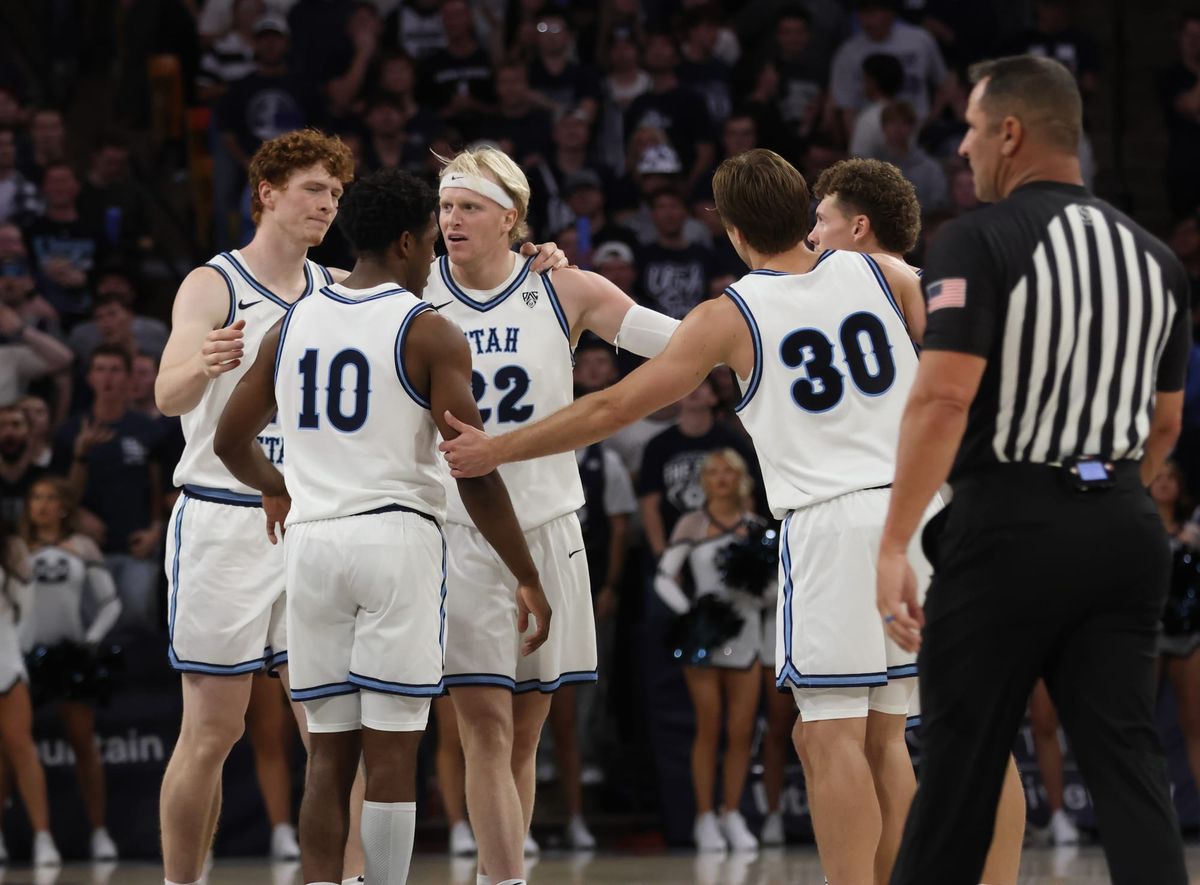
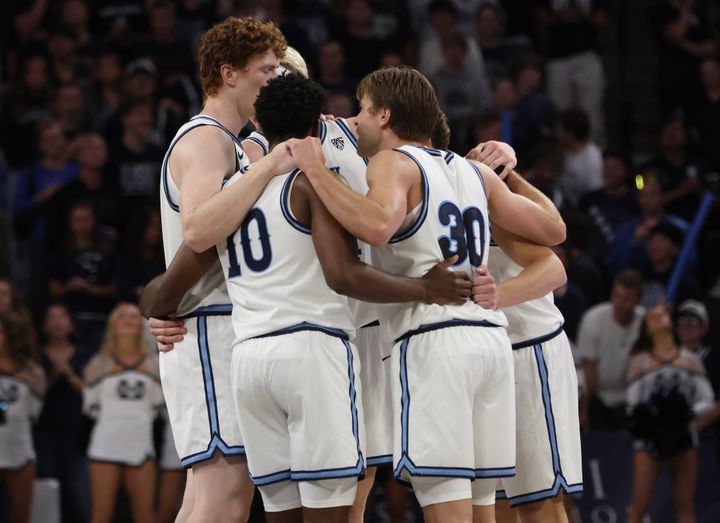
First-year Utah State head coach Ben Jacobson was, like many coaches in college basketball this offseason, wary of the instability surrounding the sport's new five-for-five eligibility rules. When he went about building his first roster in Logan, he mostly stayed away from the class of 2022 players seeking extra seasons of eligibility through the courts. Broadly speaking, it was simply more trouble than it was worth to bank on players whose availability would hinge on the opaque, oft-erratic innerworkings of both the NCAA and the legal system.
"All of that has been challenging," Jacobson told The Aggship on Aug. 26. "Certainly challenging for the coaching staff and the program, but most challenging for the players and their families and then also the players on current rosters. There are a lot of challenges in this thing. One of those challenges is how much and how fast things change. Something could be okay on this day, and within 24 hours or maybe it's three days, all of a sudden, it's different. Now you have to think through that and make decisions based on the fact that it could change again."
That didn't take much adjustment for Jacobson and Co., who had been fairly conservative with transfer portal recruiting even in the modern era at Northern Iowa, signing up eight transfers to 16 high school prospects from 2022-26. Of those eight transfers, five arrived in Cedar Falls with at least two years of eligibility remaining, including three (Leon Bond III, Marino Dubravcic and Max Weisbrod) with three or more left to play. Only Cael Schmitt (a backup guard in 2024-25), Ismaël Diouf (a backup forward in 2025-26) and Tristan Smith (a starting forward in 2025-26) were recruited as one-and-done pieces for the Panthers.
Inheriting great experience with the returns of Mason Falslev and Karson Templin, plus rising second-year incumbents Brayden Boe and Kingston Tosi, the new-look Aggie staff was free to embrace that same multi-year, developmental approach this past spring. They imported forward Will Hornseth from Northern Iowa, a two-year contributor with three still to play (including 2026-27). Next came another third-year big, Snow College center Sean Felts, and two prep seniors (Jax Allen and Jodan Boyd).
Solomon Callaghan (two years left), Ace Reiser (four), Collin Mulholland (three) and AJ Bates (three) all joined the fold by the end of April. Bron Roberts, also from Snow, wasn't far behind, bringing with him four years of remaining eligibility. Evansville's Connor Turnbull, the last addition to the roster before the summer, was the lone rising fifth-year senior – a proven plug-and-play option in an otherwise young center room. That brought the roster total to 14, one short of the max. Jacobson and his assistants had decided to leave the last spot open for a class of 2022 player, but they were comfortable leaving it be if they couldn't find the exact right fit for a roster they already felt good about.
"As we followed it and made our decision that if there was a player available in that class of 2022 – fifth-year guys, so they're going to have experience – we were going to be really specific in terms of who we added to our roster," Jacobson said. "We liked it when we got started in June, we really liked it when we got done, so we were going to be very specific and not take this decision lightly in any way shape or form."
For much of the spring and into the summer, the rumor mill focused chiefly on Ben Schwieger, a 6-8, 220-pound wing who transferred from Loyola Chicago to Northern Iowa ahead of the 2024-25 season. He was a two-year starter for the Panthers, averaging 9.8 points, 4.9 rebounds and 1.8 assists across 69 appearances (46 starts) while shooting 48.7 percent from the field and 36.9 percent from deep. It looked like a natural fit. The wing room was the least proven part of Utah State's roster, and Schwieger was already experienced in Jacobson's systems.
As days turned to weeks and weeks to months, though, the odds of that addition dropped. When Schwieger signed a professional contract with GTK Gliwice of the Polish Basketball League on July 30, most assumed (myself included) that Utah State would stand pat at 14 players.
Then Dallin Hall entered the transfer portal with a "do not contact" tag on August 18, just under two weeks from the start of fall classes at Utah State. He had been searching for professional opportunities through most of the offseason until a coach encouraged him to join one of the dozens of lawsuits filed against the NCAA.
The specifics of the various court cases are extremely difficult to track and also not really worth knowing. Regardless of which decision in particular did it, Hall got his extra year of eligibility and started thinking about what he wanted to do with it. He had initially planned to return to Virginia, where he started all 36 games in 2025-26 and averaged 5.9 points, 4.4 assists and 3.6 rebounds per contest, helping lead the Cavaliers to an ACC title berth and the second round of the NCAA tournament.
Then he received two crucial phone calls and had a change of heart, telling former Utah State and current Virginia head man Ryan Odom that he had decided to play his last year closer to home. One call came from Mason Falslev; the other from Jacobson. Hall and Falslev grew up about 50 minutes apart, Hall in Plain City and Falslev in Benson. Hall's was a Weber State family – his mom and brother were both Wildcat student athletes – while Falslev was raised in the shadow of the Spectrum, attending Aggie basketball games since he was in second grade.
In Utah's youth basketball scene, two youngsters 50 minutes apart are effectively neighbors. The two started playing against each other in either the third (in Falslev's telling) or fourth grade (per Hall's recollection), routinely meeting in championship games. Falslev, who hates to lose as much as any player I've ever covered, still has little interest in revisiting the specifics of those matchups even a decade later, given their usual result. He's much happier to recall the later years that they spent playing together.
"I've known Dallin since I was in like third grade," Falslev said. "Unfortunately, for the first four years of that relationship he was on a different team, we would always meet up in the state championship. I won't say who won, because it wasn't me, but then after that we joined a traveling team and played together for four or five years."
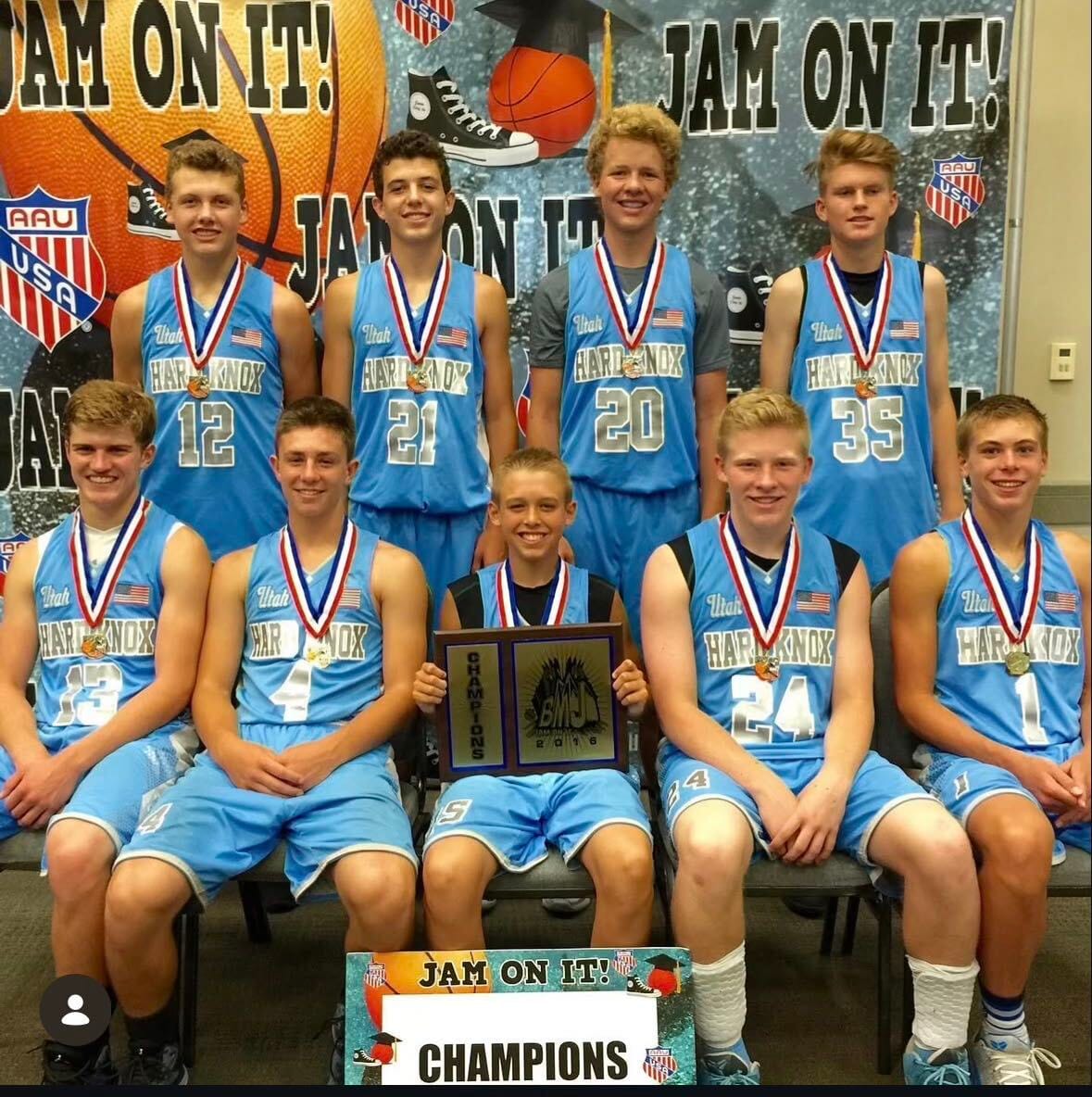
Then, it was Falslev who joined Hall on his travel team, Hard Knox. Amazingly, thanks to the meticulous archival work of one dutchhall1 on YouTube, you can actually see the two play together as early as 2016. They were an ideal match – relentless competitors eager to get up and down the floor – and their team was far better for it.
Though they went their separate ways in high school, Falslev to Sky View HS and Hall to Fremont, and landed with rival schools at Utah State and BYU when they returned from their two-year missions to Brazil (Falslev) and Fresno (Hall), they remained close. Hall followed Falslev's development in Logan, and Falslev did the same for Hall as he established himself in Provo, then at UVA last season.
"That was a big part of it," Jacobson said. "For Dallin to have an established relationship and a long relationship with Mason I think gave him some confidence and gave him a comfort level. (To make) the move at that point, a week to 10 days before classes start, that was a big part of it for him. He obviously has a lot of confidence in Mason's ability. All the things Dallin has accomplished as a player and the teams he was on, Dallin has also been following Mason because of their relationship. He's been watching Mason and following Utah State, and Dallin has a lot of confidence (in that). It's both things, the relationship and the friendship, and then also Dallin knowing that Mason's a winner. He's done a lot of it."
When Falslev called Hall in early August, his pitch was simple: It was time to turn the tables. Now Falslev had the established, quality team in need of one last piece, and he wanted to know if Hall would join him in Logan. Hall had considered a few other options, but the chance to reunite with his old friend was too much to pass on.
"It's been super cool," Hall said. "We've been playing against each other since fourth grade and started playing together in seventh grade. Back then, he joined me. This time, I joined him. To be out there on the court with him is a lot of fun. I'm super grateful for him, we have a lot of fun together and it's just the beginning. We're excited for the rest of the year."
Jacobson ran it by the team already in place, not wanting to disturb the chemistry that had already developed in the locker room, and they were on board too. Hall has a track record of putting the team (and winning) above all else, and came with a ringing endorsement from Odom, who encouraged his return to Logan as soon as Hall told him he wouldn't be returning to Virginia.
"He's the ultimate leader, he's not afraid in big moments," Odom said. "He's just unbelievable with his commitment to winning… He does everything for us."
As far as mid-August additions are concerned, Utah State could hardly ask for more.
"When we got down to it, we got into those conversations with Dallin and started to watch the film on him and learn about him and talk with people that know him, it was apparent quickly that if this worked out both ways, he would be a great fit," Jacobson told The Aggship shortly after Hall signed on. "He's a great fit in the locker room. His relationship with Mason goes way back, they played together when they were growing up, so you have that unique piece that isn't always in place. He grew up about 45 minutes or so from here, Weber State and Utah State were the two. His mom was at Weber State as a student athlete, so you have that piece of it.
"The impact he's had on winning, the teams that he's played on and the number of games, but again, that was going to be part of this. It was going to be someone who had some experience. But, his is almost on a different level in terms of the three NCAA tournaments and his impact on winning. And then I would tell you that he's a high-level player. He's a really, really good player. You combine it with all that experience, all that winning, the impact that he had on it and the relationships that were in place that are a little unique and really make this work. A lot went into it, but when it came down to getting to know Dallin, it was an easy decision at that point. He fit all of the things that we were looking for."
The Aggies had to rework their lineup a bit to accommodate the newcomer, moving Bates into a sixth-man role with Hall taking over as the lead point guard, but it's largely been a smooth transition. He fit right in with the locker room, as expected, and took to Jacobson's systems immediately. That too was all but assumed upon his arrival.
Among college point guards, Hall is as sharp as they come, and he plays a brand of basketball that requires very little adjustment from his teammates or coaches. He carried just a 12 percent usage rate for Virginia's offense last season but still created 17.1 points per game, recording a whopping 26.8 percent of Virginia's total assists while taking only 7.9 percent of its shots. He's also one of the Pac-12's most reliable backcourt rebounders and defenders, touting an 11.7 percent defensive rebounding rate and a 2.0 percent steal rate in ACC play last year at Virginia.
"His savvy is really good on both sides of the ball," Jacobson said. "Really, with everything we're doing. With our offense, our defense, our scheme and the structure of things with our program, he just has a ton of savvy. Being able to get off a guy's body, not foul and get to those plays is (great). He just has a really good feel for how to play.
"They just fit together so well. I think that's not only an important part of it when we're practicing and playing, but I think it adds a lot of joy for the two of them. To be at this point, and they don't talk about it every day how they used to do things in junior high, but I think for them to be doing this together right now, it's a pretty cool deal. They fit together so well."
Just two games into the regular season, it's easy to see the value of his pairing with Falslev. They make for a ferocious one-two punch on the defensive end, combining for seven steals and two blocks and leading the Aggies to a 79.9 defensive rating in their 49 minutes on the floor together, including a 38.5 percent effective field goal percentage (90th percentile nationally), an 18.4 percent forced turnover rate (71st percentile) and a 17.9 percent free throw rate (93rd percentile).
They've already nabbed 29 rebounds collectively, nearly 15 per game, and will get a chance to do plenty more damage on Tuesday night against an inexperienced Utah Tech backcourt that includes a freshman point guard (Christian Gibson), first-time starter Mark Brown and another freshman, Owen Mackay.
That matchup presents another major opportunity on offense, where the Falslev/Hall tandem was its most electric in a Nov. 7 blowout of Omaha. Both players hit career milestones on the evening – Hall surpassed the 1,000-point mark with a nine-point outing (4-of-8 shooting), while Falslev hit 1,500 points in his 22-point outburst (10-of-17 shooting). The Trailblazers have faced one quality opponent, falling by 40 at New Mexico in their opener, and ceded a combined 49 points on 16-of-31 shooting to Lobo guards Uriah Tenette and Jake Hall.
"There will be nights, and it could be Tuesday, when Dallin has 25," Jacobson said. "He's a really good player, and I've talked to people about that. He's so good in the way of finding teammates and getting guys shots that he sometimes doesn't get as many shots. He's able to get everyone else shots. I'm telling you, he'll have 25 here before too long in one of these games. He's a really, really good player."
Obviously, they aren't the same players now as they were back in the mid-2010s, because that was junior high, and now they're both 25. Hall made a point after the Omaha game to note how much Falslev had grown, saying he's "become an incredible basketball player" during their time apart.
Many of those old rhythms still fit, though, from timing and placement on passes to an uncanny awareness from both players of where the other will be at any given time. To see it, you need not look further than the milestone moments against Omaha. When Hall picked up his dribble on the left wing and pivoted to the center of the floor, he knew Falslev would be there waiting, ready to catch and fire the three-pointer that put him at 1,500 points.
About a minute and a half later, when Falslev collected an Omaha miss in the paint and spun toward the opposite end to start the break, his eyes went straight to Hall running the left lane. Though he hadn't yet looked back, Falslev knew Hall would be ready, and knew precisely where to place the ball as he rifled it from the opposite free throw line: A step short of the three-point line, right where Hall likes it. He caught it without breaking stride, sliced through the paint, and slammed his 1,000th point home with one hand. Hall, a big smile creeping across his face, gave his friend the customary finger point of approval. Falslev smiled right back.
"It means a lot," Hall said. "It's cool to have the pass come from Mason. I think that's kind of poetic. I'm just grateful, honestly, to have an opportunity to be playing in this jersey right now, to still be playing college basketball. I just feel a lot of gratitude. I love my team, I love the way they've embraced me and the community has embraced me. It's a lot of gratitude."
"It was pretty surreal," Falslev added. "In that moment when he dunked it, I was like, 'Geez, I can't believe that Dallin is here.' He went his way, I went my way, and it's just awesome to have him back. I'm so happy for him."
Jacobson couldn't help but smile, too. He was pretty sure it would pay off, but he took a risk adding such an important player to his roster so late in the cycle. With Falslev's blessing, though, it didn't feel so much like a risk. It just felt right.
"It probably isn't going to happen very often," Jacobson said after the Omaha game of the chance to reunite the two. "That's where my mind is going, and not just for us, but think about it around the country. The scenario you just laid out, it just isn't going to happen very often, whether it's in basketball or college athletics to have it play out the way it has with the two of them. I'm really happy for both of them.
"I know they're thrilled to be starting together in our backcourt and to be playing together and give this thing a real go side by side. Obviously as their head coach and a staff and the program, we couldn't be more fortunate to have the two of them doing it, but it's them also. They have so much fun together at practice and hanging out, and I think you can see that when they're playing. You see them smiling and having a good time, and that matters."